

Saint Bernard
Other Names: Alpine Mastiff, Bernie, SB, St Bernard, St. Bernard, Saint, Saint Dog
Country of Origin: Italy and Switzerland
Accreditation:
American Kennel Club (AKC): Working
Canadian Kennel Club (CKC): Working
United Kennel Club (UKC): Guardian Dog
Australian National Kennel Council (ANKC): Utility
The Kennel Club (KC): Working Dogs
Kennel Union of Southern Africa (KUSA): Working Dogs
National Kennel Club (NKC): Recognized
New Zealand Kennel Club (NZKC): Utility
- Height:
- 27½-35½ inches
- Weight:
- Male: 160-240 pounds
- Color(s):
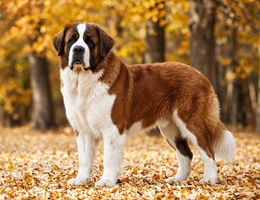
- All shades of red and white; brindle and white; or any shade of brown and white; with white markings on his chest, feet, tip of his tail, nose band, and collar or a spot on the nape of his neck
- Coat:
- Two varieties: short-haired or smooth-coat; long-haired or rough-coat
- Description:
- The Saint Bernard is one of the heaviest and largest breeds, originally bred for rescue, and as a working dog. His ancestors are the herding dogs of Swiss and Italian farmers, like the Great Swiss Mountain Dog, as well as hunting dogs, rescue dogs and watchdogs. The name "Saint Bernard" originates from a traveler's hospice on the often treacherous Saint Bernard Pass in the Western Alps between Switzerland and Italy, where the name was passed to the local dogs. The pass, the lodge, and the dogs are named for Bernard of Menthon, the 11th century monk who established the station.
- Temperament:
- The Saint Bernard is gentle, friendly, and generally fond of children. He is extremely loyal, and eager to please his owners. While generally not as aggressive as dogs bred for protection, a Saint Bernard will bark at strangers, and their size makes them good deterrents against possible intruders.
- Training:
- Due to his large adult size, it is essential that the Saint Bernard receive proper training and socialization, starting while he is still a puppy. An unruly Saint Bernard may present problems for even a strong adult, so control needs to be asserted from the beginning of the dog’s training.
- Care & Grooming:
- Proper diet and exercise is required to keep the Saint Bernard healthy.
- Shedding:
- Moderate to heavy; long-coated dogs leave more hair than the smooth variety.
- Health:
- Saint Bernards may develop hip and elbow dysplasia, bloat, entropion, and heart disease. This giant breed should grow slowly and not be exercised hard after meals.
- Lifespan:
- 8–10 years
- Litter Size:
- 6–10 puppies
Crosses that include the Saint Bernard
These hybrid pages list this breed as a parent. Open a name to see the other contributing breed.
EIW.com Copyright © 2003 - 2026 All Rights Reserved
EIW.com accepts no responsibility for the accuracy of the advertisements placed on the EIW.com website or for the contents of any website to which a hypertext link from EIW.com links. The Seller Ads and links to products and/or services are provided as a service, and EIW.com gives no warranties, expressed or implied, about the information and/or policies of the Seller Ads or the linked-to webites, or of the information shown.
EIW.com is the sole owner of the services and of all information provided by and posted to the EIW.com website. The use, reproduction, or storing of content for any purpose other than to contact a Seller, purchase a product or service, or compare prices is prohibited. You cannot use the information provided by EIW.com to recreate a directory, rebrand the informaton or redistribute the information in any way. Information provided by EIW.com is for individual, non-commercial use only. All information, processes and content contained within and that make up the services are the sole property of EIW.com. You may not reproduce, duplicate or redistribute any information provided by EIW.com for profit or personal gain of any kind. You may not frame any content or pages contained within the EIW.com website unless expressly granted permission by EIW.com.