

Shar-Pei
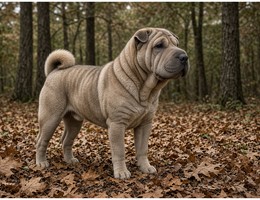
Other Names: Chinese Shar-Pei
Country of Origin: China
Accreditation:
American Kennel Club (AKC): Non-Sporting
Canadian Kennel Club (CKC): Non-Sporting
United Kennel Club (UKC): Northern Breed
Australian National Kennel Council (ANKC): Non-Sporting
The Kennel Club (KC): Utility
Kennel Union of Southern Africa (KUSA): Utility
National Kennel Club (NKC): Recognized
New Zealand Kennel Club (NZKC): Non-Sporting
- Height:
- 18-20 inches
- Weight:
- Male: 55-65 pounds; Female: 40-55 pounds
- Color(s):
- Black, cream, fawn, red-fawn, red, sable, apricot, chocolate, Isabella, or blue
- Coat:
- Brush-coat, with long hair and a smooth feel; or horse-coat, rough to the touch, extremely prickly and off-standing, in one direction soft, in the other harsh
- Description:
- The origin of the Chinese Shar-Pei can be traced to the province of Kwun Tung, and has for centuries existed in the southern provinces of China. These dogs helped their peasant masters in various tasks such as herding cattle, guarding the home and family, and have proven themselves to be qualified hunters of wild game, usually wild pigs. The Shar-Pei was bred for intelligence, strength and scowling face. During the Communist Revolution, when the Shar-Pei population dwindled dramatically, dogs were rescued by a Hong Kong business man named Matgo Law, who appealed to Americans in 1973 through a dog magazine to save the breed. Around 200 Shar-Peis were smuggled into America. The current American Shar-Pei population stems mainly from these original 200. Some people may experience a sensitivity to the harshness of the coat of either length. This is a mild, short lived rash, that can develop on the skin that has been in contact with the coat, most commonly on the forearms.
- Temperament:
- In general, the Shar-Pei has proved himself to be a loving, devoted family dog, that is very protective and independent. The Chinese Shar-Pei is a unique and intelligent dog, who can be stubborn, strong-willed and very territorial. He is often suspicious of strangers, and is a good guard dog. He is amenable to accepting strangers, given time and proper introduction at a young age. He is mostly a silent dog, barking only when playing or when worried.
- Training:
- The Shar-Pei is amenable to training, but can get bored from repetition. Early training can help control the Shar-Pei’s stubborn traits, before they become problem behaviors, such a being excessively territorial and aggressive. The Shar-Pei requires early socialization with children, strangers, and other animals, in order to have a dog that is a good family member as well as a welcome member of society.
- Care & Grooming:
- Often, the Shar-Pei can be allergic to food products that contain soy, corn, wheat, gluten, and sugars. Using a completely grain-free food to offset and try to prevent these allergies is recommended. Often the consumption of these types of poor quality foods result in allergic skin reactions. Shar-Pei whose food intake is restricted to better quality foods free of corn/soy/wheat and gluten, will enjoy much healthier lives, with little or no skin irritation, itching, or sores.
- Shedding:
- Low to moderate; the short harsh coat is easy to wipe down.
- Health:
- Shar-Pei may develop entropion, skin-fold infections, Shar-Pei fever, and hip dysplasia. Keep the wrinkles clean and dry, and watch for unexplained fever or swollen hocks.
- Lifespan:
- 8–12 years
- Litter Size:
- 4–6 puppies
Crosses that include the Shar-Pei
These hybrid pages list this breed as a parent. Open a name to see the other contributing breed.
EIW.com Copyright © 2003 - 2026 All Rights Reserved
EIW.com accepts no responsibility for the accuracy of the advertisements placed on the EIW.com website or for the contents of any website to which a hypertext link from EIW.com links. The Seller Ads and links to products and/or services are provided as a service, and EIW.com gives no warranties, expressed or implied, about the information and/or policies of the Seller Ads or the linked-to webites, or of the information shown.
EIW.com is the sole owner of the services and of all information provided by and posted to the EIW.com website. The use, reproduction, or storing of content for any purpose other than to contact a Seller, purchase a product or service, or compare prices is prohibited. You cannot use the information provided by EIW.com to recreate a directory, rebrand the informaton or redistribute the information in any way. Information provided by EIW.com is for individual, non-commercial use only. All information, processes and content contained within and that make up the services are the sole property of EIW.com. You may not reproduce, duplicate or redistribute any information provided by EIW.com for profit or personal gain of any kind. You may not frame any content or pages contained within the EIW.com website unless expressly granted permission by EIW.com.