

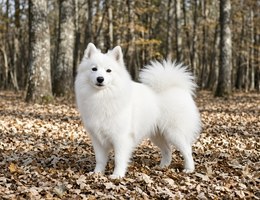
American Eskimo Dog

American Eskimo Dog
Size: Small to Medium
Other Names: Eskimo Dog, Eskie, American Spitz, American Deutscher Spitz
Country of Origin: United States (Ancestry: Germany)
Accreditation:
American Kennel Club (AKC): Non-Sporting
Canadian Kennel Club (CKC): Non-Sporting
United Kennel Club (UKC): Northern Breed
Kennel Union of Southern Africa (KUSA): Working Dogs
National Kennel Club (NKC): Recognized

The American Eskimo Dog has an overall square appearance, with a wedge–shaped head with erect triangular ears, and black nose, lips, and eye rims.  He has a thick, double coat, and his chest, neck, and forepart of his shoulders are typically covered with a lion–like mane.  His tail is richly plumed and carried over his back.

A white spitz who can share an apartment if exercised, but the coat sheds heavily and he is an alert barker.

The American Eskimo Dog is derived almost completely from the various German Spitz breeds, mainly the German Spitz crossed with Japanese Spitz and Keeshonden in America.  The Eskie is a breed of companion dog and semi–sled dog originating in the USA.  In addition to serving as a companion, it has been used as a watchdog, sled dog, and also achieved a high degree of popularity in the 1930s and 1940s US as a circus performer even as early as 1917 at the Cooper Brother's Railroad Circus.  One of many American Eskimo Dogs to walk a tightrope was an American Eskimo by the name of Stout's Pal Pierre in the Barnum " Bailey Circus.  "PR" Stout's Pal Pierre was from a long line of American Eskimos used in Barnum and Bailey's Circus acts.  Pierre's grandfather was the first known dog in the world to walk a tight rope.  The breed became popular as circuses would sell the puppies during their travels across the nation.  Although Eskies prefer cold weather, they can live in hotter climates as well.
Height
Toy: 9–13 inches; Miniature: 12–16 inches; Standard: 16–21 inches
Weight
Toy: 6–10 pounds; Miniature: 10–20 pounds; Standard: 18–35 pounds
Color
Mostly pure white; sometimes white with biscuit or cream, or cream
Coat
Thick, profuse white standoff double–coat
Lifespan
13–15 years
Litter size
3–5 puppies

Temperament

American Eskimo Dogs were bred to be companion dogs, and thrive on being a part of a human family.  They are generally highly intelligent, trainable, and moderately independent.  At home, they make excellent watchdogs, barking to announce the presence of strangers.  The Eskie can be protective of its home and family, but in general they will not threaten to attack or bite a person unless provoked.  As with all dogs, temperament is partially inherited and partially trained.  Some dogs are prone to excessive barking and separation anxiety.  It is important to research the dog's pedigree as their temperament may vary due to inheritance.  This breed is not a fast–maturing one, and Eskies can behave more like puppies than like adults for up to two years, when they finally start to mature and grow their adult coats.

Training

American Eskimo Dogs are also a very intelligent dog and need to be stimulated.  When their intelligence is not stimulated or they are ignored, they can develop behavior issues.  Owners can avoid this problem by socializing their Eskie through obedience training or participating in dog sports, such as dog agility, flyball, and dancing.

Care and grooming

Eskies have a long, dense coat and need regular grooming, which consists of brushing them once a week, or more often, if necessary.  Many Eskie owners use an undercoat rake, a tool available at most pet stores, for grooming.  Eskies should not be shaved, as the long fur helps to maintain the temperature of their skin.  Eskies typically need to be bathed only every two or three months, unless they soil their coat with large amounts of dirt or substances with strong odors.  Eskies are a very clean breed and constantly groom themselves.

Shedding

Seasonal; the dense white coat sheds heavily when the undercoat blows.

Health

American Eskimo Dogs may develop progressive retinal atrophy, patellar luxation, hip dysplasia, and tear-staining around the eyes.  Regular eye exams are recommended.

Crosses that include the American Eskimo Dog

These hybrid pages list this breed as a parent. Open a name to see the other contributing breed.

EIW.com  Copyright © 2003 - 2026 All Rights Reserved

EIW.com accepts no responsibility for the accuracy of the advertisements placed on the EIW.com website or for the contents of any website to which a hypertext link from EIW.com links.  The Seller Ads and links to products and/or services are provided as a service, and EIW.com gives no warranties, expressed or implied, about the information and/or policies of the Seller Ads or the linked-to webites, or of the information shown.

EIW.com is the sole owner of the services and of all information provided by and posted to the EIW.com website.  The use, reproduction, or storing of content for any purpose other than to contact a Seller, purchase a product or service, or compare prices is prohibited.  You cannot use the information provided by EIW.com to recreate a directory, rebrand the informaton or redistribute the information in any way.  Information provided by EIW.com is for individual, non-commercial use only.  All information, processes and content contained within and that make up the services are the sole property of EIW.com.  You may not reproduce, duplicate or redistribute any information provided by EIW.com for profit or personal gain of any kind.  You may not frame any content or pages contained within the EIW.com website unless expressly granted permission by EIW.com.